
No — in most cases, employees cannot use designated sick days for vacation. Sick leave is intended for health-related absences, and using it for planned time off typically violates company policy and, in many US states, sick leave laws.
That said, the answer depends on how your business structures its leave policies. Some employers combine sick time and vacation time into a single Paid Time Off (PTO) bank, which gives employees more flexibility. Others keep them separate — and for good reason. This guide breaks down the rules, the risks of misuse, and how to set up a leave policy that works for both you and your team.
What's the difference between sick leave and vacation time?
Sick leave and vacation time both involve time away from work, but they serve entirely different purposes — and conflating them creates real problems for employers.
Sick leave is designed for health-related absences. It covers situations like:
- A doctor's appointment or follow-up visit
- Short-term illness, such as food poisoning or flu
- Long-term medical treatment or recovery
- Caring for a sick family member or dependent
Vacation time is for planned rest and personal activities — a holiday, a family trip, or simply time to recharge. Unlike sick leave, there's no expectation that an employee is dealing with a health issue or attending a medical appointment.
Keeping these two types of leave separate protects employees who genuinely need sick time, and protects employers from operational gaps caused by unplanned absences. Allowing the lines to blur (even informally) can undermine both.
What do sick leave laws actually require?
Leave requirements vary by location, but here are the key points employers need to know:
Paid sick leave laws: Many US states mandate paid sick time for specific health-related reasons — illness, medical care, caring for a sick family member, or in some cases, domestic violence recovery. A common accrual requirement is one hour of sick leave for every 30 hours worked. A clear understanding of sick leave rules and eligibility is essential before finalising your policy. From January 2024, California law requires employers to provide at least 40 hours or five paid sick days per year to all employees who work at least 30 days for the same employer within a year — including part-time and temporary staff.
Vacation time: There is no federal requirement in the US to offer paid vacation. Most employers provide it to stay competitive, but the rules around accrual, rollover, and payout on termination vary by state, and broader annual leave laws and practices differ internationally.
Blended PTO systems: Some employers combine sick leave and vacation into a single PTO bank. Understanding the broader meaning of paid time off (PTO) helps clarify how this structure affects both flexibility and compliance. Even under this model, many states still require separate tracking of sick leave usage — so a combined policy doesn't necessarily mean simpler compliance.
Employers must also keep records showing how many paid sick days employees have earned and used, typically for at least three years, and this information must be accessible to employees.
Whatever structure you choose, your leave policies need to be clearly documented in your employee handbook and aligned with local laws to avoid issues with the labour commissioner or equivalent authority.
How do most employers manage sick leave and vacation?
The two most common approaches are separate accrual systems and combined PTO banks. Each has real trade-offs.
Separate accrual systems
The traditional approach keeps sick time and vacation time as two distinct balances. Sick leave accrues based on hours worked; vacation days accrue separately, often as a fixed accrual leave allowance (ten days per year is common for full-time staff).
This approach makes it easier to prevent misuse (employees know sick days are strictly for illness or medical appointments) and simplifies record-keeping when state law requires separate sick leave tracking. The downside: unused sick days can accumulate without benefit, particularly if employees can't convert them or carry them over.
Combined PTO banks
An increasingly common alternative is pooling sick time, vacation days, and personal days into a single PTO balance. A well-structured PTO policy outlines how this pooled time is earned, managed, and used. Employees use their accrued time however they choose (a doctor's appointment, a child's school event, a long weekend) without needing to categorise the absence.
Benefits include greater employee flexibility, reduced administrative overhead, and higher job satisfaction. For some organisations, discretionary time off (DTO) is an even more flexible option, though it raises its own management challenges. The risk is that employees may use all their PTO for holidays, leaving nothing for a genuine illness — which can result in unpaid leave or operational disruption at the worst possible moment.
Can an employee get in trouble for using sick days as holiday?
Yes — and the consequences can be serious for both the employee and the employer.
- For employees: Using sick leave dishonestly (claiming illness to take a planned trip, for example) is considered a violation of company policy in most organisations. If an employer discovers the misuse, consequences can include formal warnings, loss of accrued time, or in serious cases, termination. When issues persist, a structured employee attendance write-up process helps document violations fairly. In extreme cases where fraud is involved, there may be legal implications too. Misrepresenting the reason for an absence also damages trust in a way that's difficult to rebuild. Future leave requests (even legitimate ones) may face greater scrutiny.
- For employers: Failing to enforce sick leave policies clearly creates compliance risks. If an employer suspects misuse but handles it inconsistently or without documentation, they may face retaliation claims. In regulated environments, unclear policies can also trigger audits.
The cleaner your leave policies are (and the more consistently they're applied) the less exposure your business carries.
👉 Related read: Why Employees Are Calling in Sick When Denied Vacation & How To Stop It
How to prevent sick leave misuse without creating a culture of distrust
The goal isn't to treat employees as suspects — it's to build a system where policies are clear and consistently applied. Here's what works:
-
Write it down. Your employee handbook should spell out exactly what sick leave can be used for, with examples (a doctor's appointment, recovering from illness, caring for a sick family member). Misuse — such as using a sick day for a personal trip — should be explicitly addressed, including the consequences.
-
Use verification proportionally. Requiring a doctor's note for absences over a few consecutive days is reasonable and widely accepted. Applying it to every single sick day creates friction and signals distrust. Set a clear threshold in your policy and apply it consistently.
-
Flag patterns, not individuals. A good absence management system will surface patterns — recurring sick days on Mondays, spikes before bank holidays — without requiring managers to monitor staff manually. Tracking and interpreting your employee absence rate turns these patterns into actionable insight. Act on data, not suspicion.
-
Consider whether your policy structure is part of the problem. If employees are regularly "pulling sickies" to get time off, a combined PTO policy may reduce the incentive. Giving employees more flexibility in how they use their leave often reduces misuse rather than encouraging it. Some companies offer unlimited PTO; but even then, state sick leave tracking requirements still apply, so compliance can't be ignored.
-
Train your managers. Supervisors need to know how to handle a leave violation; what counts as evidence, how to document it, and what the escalation process looks like. They should also understand how leave misuse connects to missed shifts and staffing gaps. Inconsistent enforcement is one of the most common compliance risks.
Should you switch to a combined PTO policy?
A combined PTO policy isn't right for every business, but it's worth considering seriously — particularly if you're managing shift-based teams where flexibility matters and occasionally need to approve a longer leave of absence.
Arguments for a combined policy:
- Employees don't need to categorise their absences, reducing the temptation to misrepresent reasons for time off
- One balance is easier to track and administer than two
- Greater autonomy over time off is consistently linked to higher job satisfaction and lower turnover
Arguments for keeping them separate:
- Some state and local laws require separate tracking of sick leave regardless of your internal policy
- Employees who use all their PTO for holidays may find themselves without cover when genuinely ill, creating unpaid leave situations and staffing gaps
- Separate balances give employers cleaner documentation for compliance purposes
Practical checklist before switching:
- Check whether your state or local laws require separate sick leave tracking
- Decide on your accrual method — does PTO accrue hourly, or is it granted as a lump sum at the start of the year, and how will leave accrual be calculated and displayed?
- Set a clear rollover rule — does unused PTO carry over, or does a "use it or lose it" rule apply?
- Choose or update your vacation scheduling software so employees and managers have real-time visibility into balances and approvals
- Update your employee handbook before communicating any changes to staff
- Ensure your time and attendance software and absence tracking system can handle the new structure and stay compliant
Manage leave without the admin headache
Whether you run separate sick leave and vacation balances or a combined PTO policy, the mechanics (tracking accruals, approving requests, flagging patterns, syncing to the schedule) take real time every week, especially if you're still relying on manual processes instead of a modern shift booking system or online shift planning.
Shiftbase brings absence management, employee scheduling, and time tracking into one connected system, with robust automated scheduling tools and integrated employee timekeeping. Employees submit leave requests from the app. Managers approve with one tap. Balances update automatically. When someone calls in sick, the gap appears in the schedule immediately; so it gets filled, not discovered too late.
Try Shiftbase free for 14 days — no credit card required, or explore our pricing plans to see which package fits your team best.
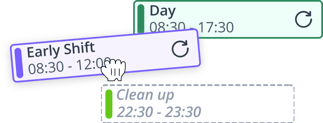
- Automatic accrual of vacation hours
- Request leave easily
- Leave registrations visible in the planning